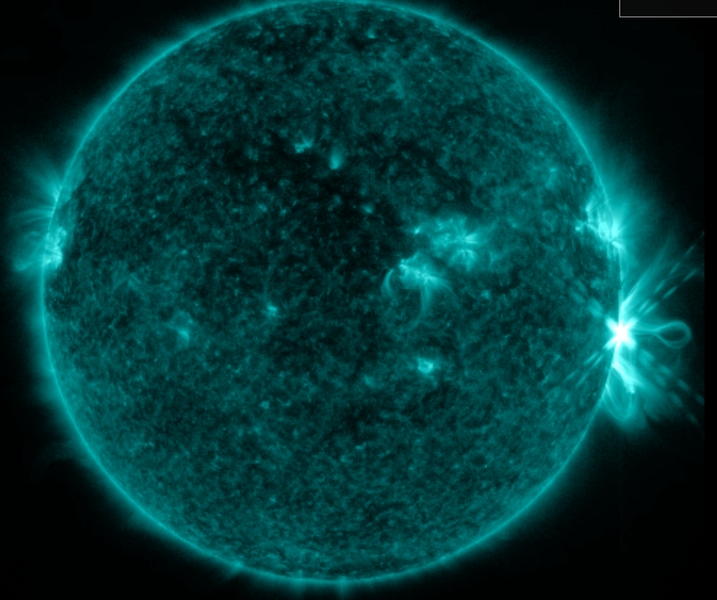
In findings published in Nature Astronomy, scientists at the New Jersey Institute of Technology (USA) and the German Institute of Solar Physics (KIS) have pinpointed a previously unknown class of high-energy particles in the Sun’s upper atmosphere responsible for generating the long-puzzling gamma-ray radiation observed during major solar flare events for decades.
The signals were traced back to a localized region in the solar corona during a powerful X8.2-class flare that erupted on September 10, 2017, where trillions upon trillions of particles were measured at energies of several million electron volts (MeV) — hundreds to thousands of times more energetic than typical flare particles and moving near the speed of light.
The team says the discovery fills critical gaps in our understanding of solar flare physics and could improve models of solar activity that ultimately enhance space weather forecasting.
To find the source, the team combined observations of the 2017 flare from NASA’s Fermi Gamma-ray Space Telescope and the Expanded Owens Valley Solar Array (EOVSA), a state-of-the-art radio telescope array in California.
Fermi provided crucial measurements of high-energy gamma-ray emissions during the flare, while EOVSA delivered spatially resolved microwave imaging that captured the signatures of accelerated particles in the solar corona.
By analyzing these datasets together, the team identified a distinct region in the solar atmosphere, called Region of Interest 3 (ROI 3), where microwave and gamma-ray signals converged. This convergence pointed to a unique population of particles energized to MeV levels.
ROI 3 is located near regions ROI 1 and ROI 2, where significant magnetic field decay and intense particle acceleration take place, which were studied earlier.
Unlike the typical electrons accelerated in solar flares, which usually decrease in number as their energy increases, this newly discovered population is unusual because most of these particles have very high energies—on the order of millions of electron volts—with relatively few lower-energy electrons present.
Using advanced modeling, the team linked the energy distribution of these particles directly to the observed gamma-ray spectrum, pointing to bremsstrahlung emission—high-energy light usually produced when electrons collide with solar plasma—as the elusive source of the gamma-ray signals.
Figure 1:
X8.2‑class flare of 10 September 2017 observed by the SDO/AIA instrument in extreme ultraviolet channel 131 Å. The bright area on the western limb shows the flare location. It is connected by a thin plasma sheet with ascending balloon-like structure (solar eruption). Source: NASA